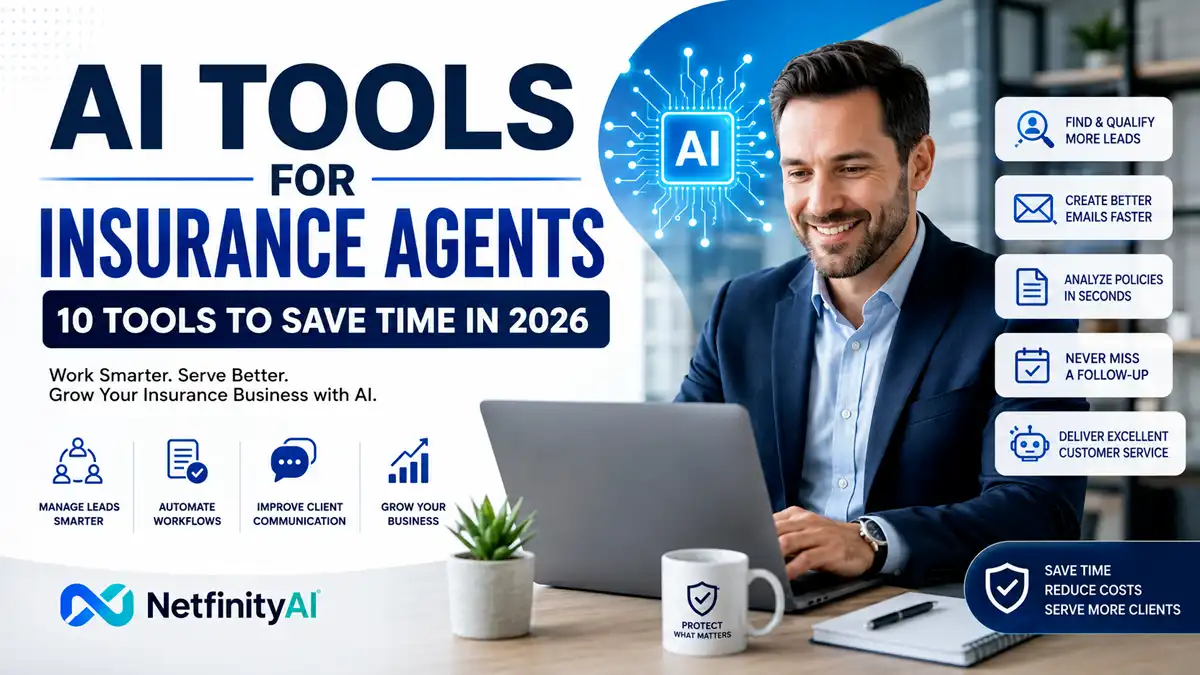
AI Tools for Insurance Agents: 10 Tools to Save Time in 2026
Insurance agents spend a surprising amount of time on tasks that don’t directly involve selling policies or helping clients. Following up with prospects, summarizing calls, reviewing documents, preparing emails, updating CRM records, answering repetitive questions, and keeping track of renewals can quickly fill an agent’s day.
AI is changing how some of these tasks are handled.
Instead of treating AI as a replacement for an insurance professional, agents can use it as a productivity layer around their existing workflow. An AI assistant can summarize a client conversation, draft a follow-up email, organize information from a document, generate marketing ideas, or automate repetitive administrative steps.
The important question isn’t whether insurance agents should use AI. It’s which AI tools actually solve useful problems without creating new risks around accuracy, privacy, or compliance?
In this guide, we’ll examine 10 AI tools and tool categories that can help insurance agents with prospecting, communication, documentation, customer service, marketing, and workflow automation.
At a Glance
| Insurance Agent Task | AI Tool Type to Consider | Main Benefit |
|---|---|---|
| Finding prospects | AI lead-generation tools | More efficient prospecting |
| Lead qualification | AI sales assistants | Faster prioritization |
| Customer emails | AI writing assistants | Faster communication |
| Calls and meetings | AI meeting assistants | Automatic summaries |
| Policy documents | AI document analysis | Faster information extraction |
| Customer questions | AI support tools | Faster responses |
| Follow-ups | AI CRM tools | Fewer missed opportunities |
| Marketing | AI content tools | Faster content production |
| Renewals | AI workflow automation | More consistent follow-up |
| Repetitive admin | AI automation platforms | Less manual work |
Quick Take
The right AI setup depends on the type of insurance business you run.
An independent agent may benefit most from tools that improve prospecting, follow-ups, and customer communication. A larger agency may get more value from AI connected to its CRM, customer service systems, documents, and internal workflows.
Start with one repetitive task that consumes significant time. Solve that problem first, then expand your AI workflow gradually.
How AI Can Help Insurance Agents
AI can support insurance agents across several parts of the customer journey.
Lead Generation and Prospecting
Finding and prioritizing potential customers is one of the most important parts of an agent’s job. AI-powered sales and prospecting tools can help organize leads, identify potential prospects, and assist with personalized outreach.
The goal isn’t simply to generate more leads. It’s to help agents spend more time on prospects that are actually worth contacting.
Customer Communication
Insurance involves frequent communication. Customers may need explanations, updates, reminders, documents, and answers to routine questions.
AI can help agents draft emails, summarize conversations, rewrite complicated explanations in simpler language, and prepare follow-up messages.
The agent should still review important communications before sending them, particularly when they involve coverage, exclusions, pricing, claims, or contractual information.
Document Analysis
Insurance professionals regularly work with policies, applications, forms, reports, and other documents.
AI document-analysis tools can help extract information, summarize lengthy documents, and locate specific details faster.
This can reduce time spent manually searching through documents, although important information should always be verified against the original source.
Follow-Up and CRM Management
A lead that doesn’t receive a timely follow-up can easily be forgotten.
AI-powered CRM and automation tools can help agents organize customer information, create reminders, summarize interactions, and trigger routine workflow steps.
This is particularly useful for agents managing a large pipeline.
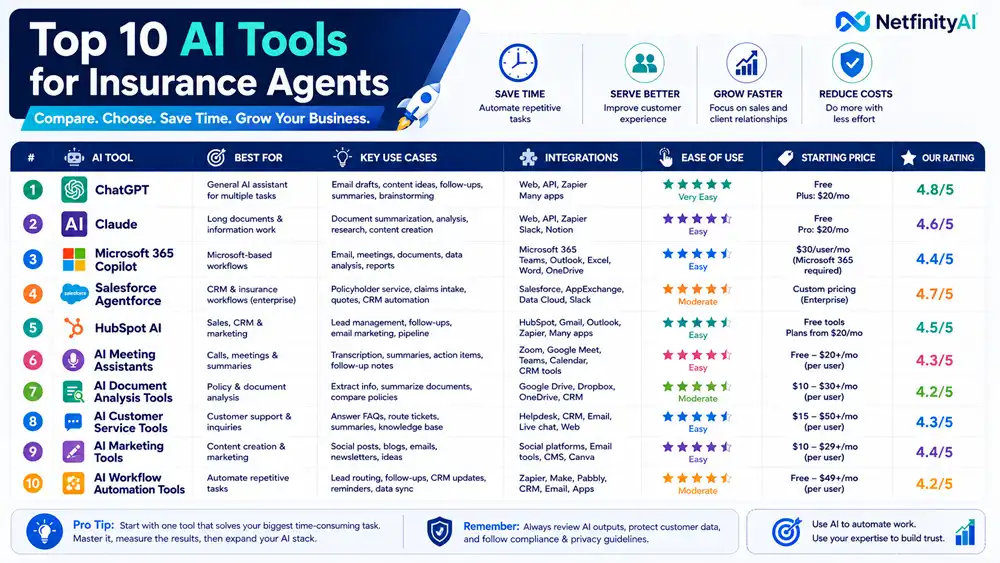
10 AI Tools for Insurance Agents
We’ll evaluate each tool based on what problem it solves, rather than simply listing features.
1. ChatGPT — Best General AI Assistant
ChatGPT can serve as a flexible AI assistant for insurance agents who need help with everyday tasks.
An agent can use it to brainstorm marketing ideas, draft customer emails, summarize non-sensitive notes, create follow-up templates, prepare social media content, or turn rough ideas into structured documents.
Its flexibility makes it particularly useful for agents who don’t yet need a specialized insurance AI platform.
Best Uses
- Email drafting
- Marketing ideas
- Social media content
- Follow-up templates
- Brainstorming
- Summarizing provided information
- Creating checklists
Best For
Independent insurance agents who want one flexible AI assistant for multiple tasks.
Important Consideration
Don’t paste confidential customer information, sensitive personal data, policy details, or other restricted information into an AI service unless your organization’s policies and the service’s data controls permit it.
2. Claude — Best for Document and Information Work
Claude can be useful when an insurance agent needs to work with substantial amounts of text.
For example, an agent might use an AI assistant to summarize a long document, organize notes, compare information, or transform complicated material into a clearer internal summary.
Best Uses
- Long-document summarization
- Information organization
- Drafting
- Analysis
- Research assistance
Best For
Agents who frequently work with lengthy documents and text-heavy information.
3. Microsoft 365 Copilot — Best for Microsoft-Based Workflows
If your agency already relies heavily on Microsoft 365, Copilot can be useful because it works within the broader Microsoft work environment.
Insurance agents can use an AI assistant for tasks such as drafting communications, summarizing information, preparing documents, and working with business content. Microsoft-focused AI is particularly relevant for teams already using tools such as Outlook, Word, Teams, and Excel.
Research on Microsoft Copilot usage in 2026 also shows that workplace use extends beyond simple question answering into writing, information retrieval, analysis, decision-making, and other knowledge-work activities.
Best Uses
- Email assistance
- Meeting summaries
- Document drafting
- Information retrieval
- Data analysis
- Business communication
Best For
Insurance agencies already using Microsoft 365 extensively.
Pros
- Fits into an existing Microsoft workflow
- Useful across multiple business tasks
- Helpful for communication and document work
Cons
- Most valuable when your organization already uses Microsoft’s ecosystem
- Licensing and available features depend on the plan
4. Salesforce Agentforce — Best for Insurance CRM Workflows
Salesforce has moved beyond traditional CRM assistance with Agentforce, its AI-agent platform. Its insurance-focused capabilities are particularly relevant for larger agencies, brokerages, and insurance organizations.
Salesforce’s current insurance solution can provide policyholder portfolio summaries, quote overviews, and proof-of-insurance information using its insurance data model. Its insurance service capabilities also support workflows around policy servicing, claims intake, complaints, and customer inquiries.
This makes Agentforce fundamentally different from a general AI writing assistant. It is designed to work with business data and execute workflows within the Salesforce environment.
Best Uses
- Policyholder information
- Customer service
- Claims intake
- Quote information
- CRM workflows
- Automated service tasks
Best For
Larger insurance agencies, brokerages, and organizations already using Salesforce.
Pros
- Deep CRM integration
- Insurance-specific capabilities
- Supports AI agents and automated workflows
- Useful for larger organizations
Cons
- More complex than a standalone AI assistant
- Better suited to organizations with an established Salesforce environment
- Enterprise-oriented features may be excessive for a solo agent
5. HubSpot AI — Best for Insurance Sales and CRM
HubSpot can be useful for insurance agents who want to combine customer relationship management, marketing, sales, and automation in one system.
Its insurance CRM offering is designed around managing policyholder information, sales pipelines, customer interactions, and renewal workflows.
For an insurance agent, this can be particularly useful when the biggest problem isn’t writing content—it’s keeping track of leads and making sure prospects and existing customers receive timely follow-ups.
Best Uses
- Lead management
- CRM organization
- Follow-up automation
- Marketing
- Customer communication
- Sales pipeline management
Best For
Independent agents and growing agencies that need CRM plus marketing and automation.
Pros
- Combines CRM and marketing
- Useful for managing leads
- Automation capabilities
- Can support the full customer lifecycle
Cons
- Not exclusively an insurance platform
- Advanced capabilities can require paid plans
- Setup takes more effort than using a simple AI assistant
6. AI Meeting Assistants — Best for Calls and Client Meetings
Insurance agents can spend significant time in phone calls, consultations, team meetings, and client discussions.
AI meeting assistants can automatically transcribe conversations, summarize key points, identify action items, and create follow-up notes.
Instead of manually reconstructing a conversation after every meeting, an agent can review an AI-generated summary and focus on the next action.
Best Uses
- Meeting transcription
- Call summaries
- Action items
- Follow-up preparation
- Internal meeting notes
Best For
Agents who spend a large part of their day on calls and consultations.
Important Tip
Always consider consent, recording laws, company policy, and applicable privacy requirements before recording customer conversations.
7. AI Document Analysis Tools — Best for Policy Information
Insurance work involves documents that can be lengthy and difficult to search manually.
AI document-analysis tools can help extract specific information, summarize documents, and organize large amounts of text.
For example, an agent might use AI to locate relevant information within a document before manually verifying the original source.
Best Uses
- Document summarization
- Information extraction
- Policy comparison
- Finding specific clauses
- Organizing notes
Best For
Agents who regularly work with lengthy policy and business documents.
Important Tip
AI-generated summaries should be treated as an aid—not the authoritative source. Always verify important coverage, exclusions, limits, dates, and other contractual details against the original document.
8. AI Customer-Service Tools — Best for Routine Questions
Customer service is another area where AI can reduce repetitive work.
An AI-powered support system can help answer common questions, direct customers to relevant information, summarize conversations, or route more complex requests to a human agent.
This can be particularly useful for agencies receiving repetitive questions about documents, appointments, basic processes, and account information.
Best Uses
- Frequently asked questions
- Initial customer responses
- Support routing
- Knowledge-base assistance
- Conversation summaries
Best For
Agencies handling a high volume of routine customer inquiries.
Important Limitation
Insurance questions can involve significant financial and contractual consequences. AI should not be allowed to confidently improvise coverage advice or make decisions that require a licensed professional.
9. AI Marketing Tools — Best for Generating Content
Insurance agents need to market consistently, but creating social posts, emails, newsletters, and promotional content can become another time-consuming task.
AI marketing tools can help agents brainstorm topics, create content drafts, repurpose existing material, and maintain a more consistent publishing schedule.
For example, an agent could turn a common customer question into a LinkedIn post, Facebook post, email newsletter, or short educational article.
Best Uses
- Social media content
- Email marketing
- Blog ideas
- Content repurposing
- Marketing campaigns
- Customer education
Best For
Agents who want to build an online presence without spending hours creating every piece of content manually.
Important Tip
Insurance marketing can be subject to company, regulatory, and platform-specific requirements. AI-generated marketing copy should always be reviewed before publication.
10. AI Workflow Automation Tools — Best for Repetitive Tasks
Workflow automation may be one of the most practical uses of AI for a busy insurance agent.
Instead of manually moving information between different applications, automation platforms can connect systems and trigger actions based on specific events.
For example:
New lead → CRM entry → notification → follow-up task → email reminder
A more advanced workflow might connect lead forms, CRM systems, calendars, email platforms, and internal notifications.
Best Uses
- Lead routing
- Follow-up reminders
- CRM updates
- Email workflows
- Notifications
- Data synchronization
- Repetitive administrative tasks
Best For
Insurance agents and agencies with repetitive processes across multiple software platforms.
Pros
- Reduces manual work
- Connects different applications
- Can improve consistency
- Useful for scaling operations
Cons
- Requires initial setup
- Poorly designed automation can create errors
- Sensitive customer information needs careful handling
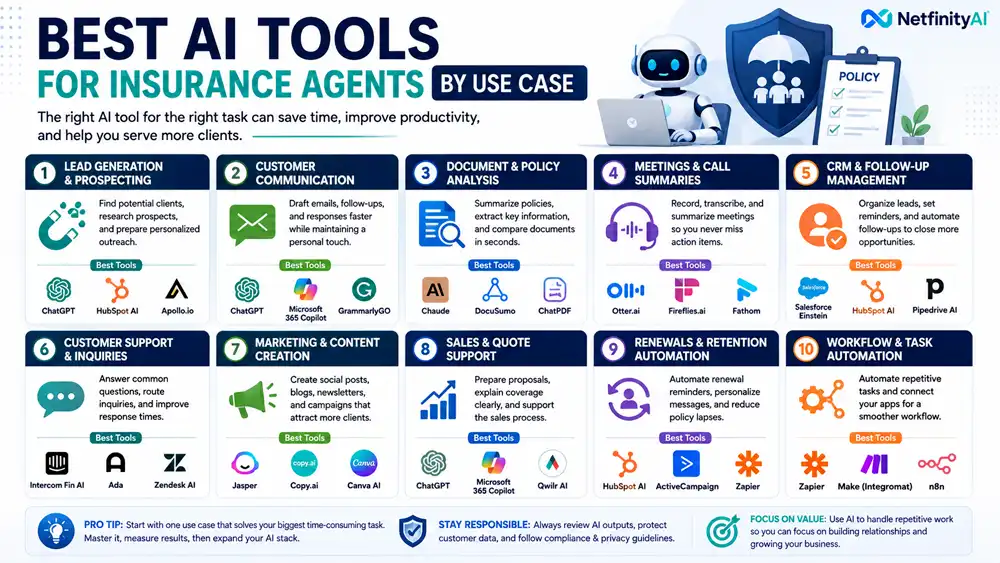
Best AI Tools for Insurance Agents by Use Case
There isn’t one AI tool that is automatically best for every insurance professional. The right choice depends on the job you want the software to perform.
| Use Case | Recommended Tool Type | Best For |
|---|---|---|
| General AI assistance | ChatGPT or Claude | Individual agents |
| Microsoft workflow | Microsoft 365 Copilot | Microsoft users |
| CRM automation | Salesforce Agentforce | Larger organizations |
| Sales & CRM | HubSpot | Growing agencies |
| Meetings | AI meeting assistant | Client calls |
| Documents | AI document analysis | Policy-heavy workflows |
| Customer support | AI support platform | High inquiry volume |
| Marketing | AI marketing platform | Content creation |
| Automation | AI workflow platform | Repetitive processes |
Best AI Tool for Independent Insurance Agents
For an independent agent, starting with a flexible AI assistant can make more sense than immediately adopting an expensive enterprise platform.
A general AI assistant can help with writing, brainstorming, customer communication drafts, marketing ideas, and administrative tasks.
Best starting point: ChatGPT or Claude.
Best AI Tool for Insurance Agencies
Growing agencies may benefit more from combining AI with CRM and workflow automation.
The advantage is that customer information, leads, follow-ups, and business processes can be managed within a more connected system.
Best starting point: A CRM with integrated AI and automation.
Best AI Tool for Insurance Sales
Sales-focused AI can help agents organize prospects, prioritize leads, prepare outreach, and maintain follow-up workflows.
However, the quality of the underlying CRM data matters just as much as the AI.
Best AI Tool for Customer Service
Agencies dealing with large numbers of routine questions can consider AI-powered support and knowledge-base solutions.
The safest approach is to let AI handle well-defined, low-risk questions and route complex coverage or claims questions to qualified professionals.
How to Choose the Right AI Tool for Your Insurance Business
Before paying for an AI platform, identify the bottleneck you actually want to solve.
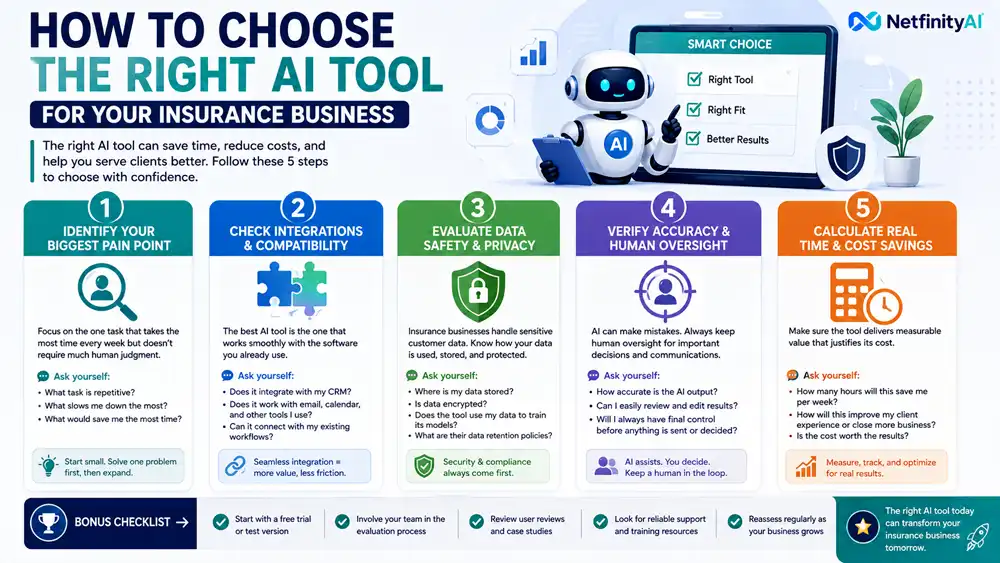
1. Start With One Repetitive Task
Don’t try to automate your entire agency at once.
Ask:
What task takes the most time every week but doesn’t require much human judgment?
That could be meeting notes, follow-up reminders, content creation, document searching, or CRM updates.
Start there.
2. Check Integrations
An AI tool becomes much more useful when it works with the software you already use.
Check compatibility with your:
- CRM
- Calendar
- Helpdesk
- Agency management system
- Document storage
- Marketing platforms
3. Evaluate Data Handling
Insurance businesses can handle sensitive personal and financial information.
Before uploading customer information or connecting an AI platform to business systems, review:
- Privacy policies
- Data retention
- Security controls
- Access permissions
- Data-training policies
- Compliance requirements
4. Don’t Ignore Accuracy
AI can produce convincing but incorrect information.
For insurance-related work, that matters.
Never rely blindly on AI for coverage interpretation, policy decisions, claims decisions, legal conclusions, or other high-impact professional judgments.
5. Calculate the Real Time Savings
An AI subscription is worthwhile only if it creates measurable value.
For example:
2 hours saved per week × 4 weeks = 8 hours saved per month
If a tool costs money but barely changes your workflow, it may not be worth keeping.
AI, Privacy, Compliance, and Insurance
This deserves special attention.
Insurance agents work with information that can be highly sensitive. AI should therefore be introduced carefully.
A good rule is:
Use AI aggressively for low-risk productivity tasks and cautiously for sensitive customer information.
For example, generating generic marketing ideas is very different from uploading a customer’s complete policy and asking AI to determine whether a claim should be covered.
Before deploying AI across an agency, establish clear rules for:
- What information employees can enter into AI tools
- Which tools are approved
- Who can access AI-generated information
- How customer information is stored
- When human review is mandatory
- How automated customer interactions are monitored
For regulated insurance activities, your organization’s legal, compliance, and security requirements should take priority over AI convenience.
Our Top 3 AI Tools for Insurance Agents
🥇 ChatGPT — Best Overall Starting Point
For individual agents who want a flexible AI assistant, ChatGPT is a practical starting point for writing, brainstorming, content creation, summarization, and general productivity.
🥈 Microsoft 365 Copilot — Best for Microsoft Users
If your agency already works extensively with Microsoft 365, Copilot can fit naturally into existing email, document, meeting, and productivity workflows.
🥉 Salesforce Agentforce — Best for Enterprise CRM Workflows
For larger insurance organizations already operating on Salesforce, Agentforce provides a much more connected approach to AI-assisted customer and CRM workflows.
The key takeaway: Don’t choose the most powerful AI platform simply because it has the most features. Choose the one that solves your biggest operational problem.
Frequently Asked Questions
What are the best AI tools for insurance agents?
The best option depends on the task. General AI assistants such as ChatGPT can help with writing and productivity, while CRM platforms, document-analysis tools, customer-service systems, and automation platforms can address more specialized insurance workflows.
How can insurance agents use AI?
Insurance agents can use AI for prospecting, customer communication, meeting summaries, document analysis, marketing, CRM management, customer support, follow-ups, and workflow automation.
Can AI replace insurance agents?
AI can automate or assist with many repetitive tasks, but it does not replace the professional judgment, relationship management, expertise, and regulatory responsibilities of an insurance agent.
Are AI tools safe for insurance agents?
They can be useful, but safety depends on how they’re configured and used. Agents should understand each platform’s privacy, security, data retention, and access policies before using it with sensitive customer information.
Can AI help insurance agents generate leads?
Yes. AI can assist with prospect research, lead qualification, content creation, outreach preparation, and CRM workflows. However, lead quality and human follow-up remain important.
What is the best AI tool for an independent insurance agent?
A flexible AI assistant is usually the easiest place to start because it can support multiple everyday tasks without requiring a large technology implementation.
Final Verdict
AI is becoming a practical productivity layer for insurance professionals, but the best results don’t come from handing every task to a chatbot.
The strongest approach is to identify repetitive work, automate what is safe to automate, and keep human oversight where accuracy, customer trust, professional judgment, or compliance matters.
For individual agents, ChatGPT is a strong starting point because of its flexibility. Agencies already using Microsoft products may find Microsoft 365 Copilot more convenient, while larger organizations with Salesforce infrastructure can explore Agentforce for deeper CRM and workflow integration.
Start small, measure the time saved, and expand only when the results justify it.
Related Articles
Place these at the very end of the article: