
Best AI Tools for Product Managers (2026): 15 Top Picks
AI has changed how product managers research ideas, analyze customer feedback, plan roadmaps, write requirements, and collaborate with development teams. Instead of handling every repetitive task manually, product managers can now use AI tools to speed up research, organize information, generate documentation, and make better-informed product decisions.
The challenge is choosing the right tool. Some AI platforms are designed for product discovery and customer research, while others are better for project management, analytics, documentation, wireframing, or team collaboration.
The best AI tools for product managers can help reduce repetitive work while giving product teams more time to focus on strategy, prioritization, and customer needs. However, not every AI tool is equally useful for every stage of the product lifecycle.
In this guide, we compare 15 of the best AI tools for product managers in 2026. We’ll look at their key features, strengths, limitations, pricing approach, and best use cases so you can identify the tools that fit your product management workflow.
At a Glance
| Tool Category | Best For |
|---|
| Product Research | Customer insights and discovery |
| Roadmapping | Product planning and prioritization |
| Project Management | Managing product workflows |
| Analytics | Understanding user behavior |
| Documentation | PRDs, requirements, and knowledge |
| Design | Wireframes and prototypes |
| Team Collaboration | Cross-functional communication |
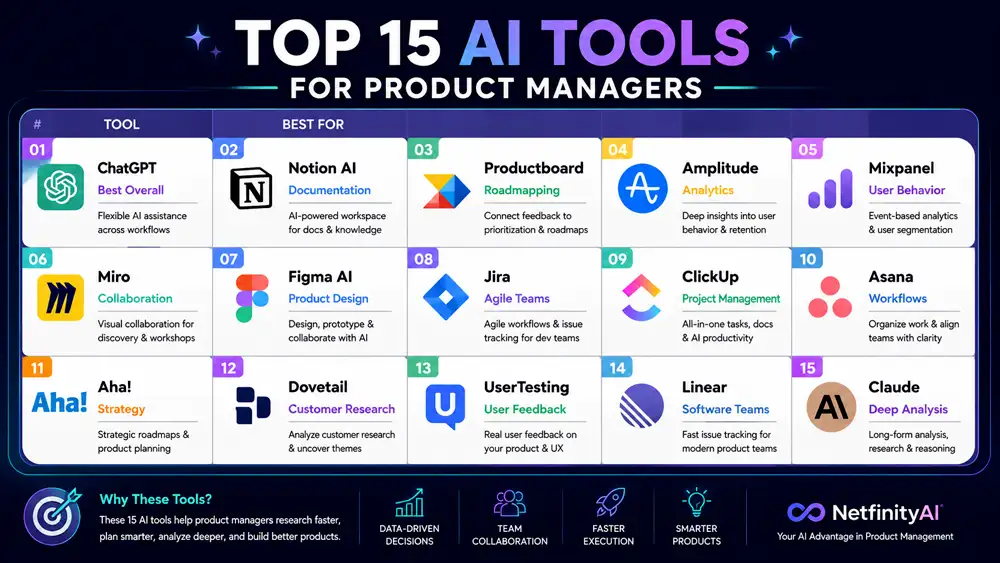
Quick Comparison Table
| AI Tool | Best For | Key Strength | Best For |
|---|---|---|---|
| ChatGPT | Product strategy & research | Flexible AI assistance | All-round product work |
| Notion AI | Documentation | AI-powered workspace | PRDs & knowledge |
| Productboard | Product planning | Roadmaps & prioritization | Product teams |
| Amplitude | Product analytics | User behavior insights | Data-driven decisions |
| Mixpanel | Product analytics | Event-based analytics | Growth teams |
| Miro | Collaboration | Visual planning | Workshops & discovery |
| Figma AI | Product design | UI & prototyping | Product designers |
| Jira | Development management | Agile workflows | Software teams |
| ClickUp | Project management | AI productivity | Cross-functional teams |
| Asana | Workflow management | Task coordination | Product operations |
| Aha! | Roadmapping | Product strategy | Roadmap planning |
| Dovetail | Customer research | Research repository | User insights |
| UserTesting | User research | Customer feedback | Product discovery |
| Linear | Product development | Fast issue tracking | Modern product teams |
| Claude | Research & reasoning | Long-form analysis | Complex product work |
How We Selected These AI Tools
Product managers need more than a chatbot that can generate text. The most useful AI tools should support actual product workflows, from discovering customer problems to planning features and measuring results.
For this list, we considered several factors:
- Product research: How effectively the tool helps teams understand customers, markets, and competitors.
- Planning and roadmapping: Whether it supports prioritization, product roadmaps, requirements, and planning.
- Analytics: The ability to turn product and customer data into useful insights.
- Documentation: How well it supports PRDs, meeting notes, specifications, and internal knowledge.
- Collaboration: Whether product managers can work effectively with designers, developers, marketers, and executives.
- AI capabilities: The usefulness of AI-generated recommendations, summaries, analysis, and automation.
- Ease of use: How quickly a product manager can incorporate the tool into an existing workflow.
- Value: Whether the features justify the cost for individuals, startups, and larger teams.
No single platform is perfect for every product team. That’s why this guide includes specialized tools alongside broader AI platforms.
1. ChatGPT
ChatGPT is one of the most versatile AI tools for product managers because it can assist with many stages of the product lifecycle. Product managers can use it for brainstorming, customer research, competitive analysis, PRD drafts, feature ideas, user stories, meeting summaries, and strategic planning.
Its flexibility is particularly useful when a product manager needs to move quickly between different tasks. Instead of using a separate AI application for every small job, teams can use one general-purpose assistant for research, writing, analysis, and ideation.
Key Features
- Product brainstorming
- Market research assistance
- PRD and user-story drafting
- Competitive analysis
- Data analysis
- Meeting and document summarization
- Strategic planning
Best For
Product managers who want one flexible AI assistant for multiple workflows.
Pros
- Extremely versatile
- Useful across the entire product lifecycle
- Strong writing and reasoning capabilities
- Works well for brainstorming and analysis
Cons
- Requires good prompts and human judgment
- Specialized product-management platforms can offer deeper workflow integrations
2. Notion AI
Notion AI combines AI assistance with a workspace designed for notes, documentation, project information, and team knowledge.
For product managers, this makes it especially useful for creating and maintaining product documentation. Teams can use it to summarize meeting notes, organize information, draft requirements, rewrite documents, and find information within their workspace.
Key Features
- AI writing assistance
- Document summarization
- Workspace search
- Meeting-note assistance
- Product documentation
- Knowledge management
Best For
Product managers who keep product documentation and team knowledge in Notion.
Pros
- Excellent documentation workflow
- Combines workspace and AI
- Useful for collaborative teams
- Flexible database and page structure
Cons
- Not a dedicated product analytics platform
- Advanced product-management workflows may require additional tools
3. Productboard
Productboard is designed specifically around product management, making it different from general-purpose AI assistants.
It helps product teams organize customer feedback, identify product opportunities, prioritize ideas, and communicate product strategy through roadmaps.
Its biggest advantage is the connection between customer insights and product planning. Instead of keeping feedback, feature requests, and roadmap decisions in disconnected systems, product teams can organize them within a dedicated product-management environment.
Key Features
- Product roadmaps
- Customer feedback management
- Feature prioritization
- Product discovery
- Product strategy
- Team collaboration
Best For
Product teams that need structured product discovery, prioritization, and roadmapping.
Pros
- Purpose-built for product management
- Strong prioritization workflow
- Useful for customer feedback
- Good for communicating product strategy
Cons
- More specialized than general AI tools
- May be unnecessary for very small teams
4. Amplitude
Amplitude is a product analytics platform that helps product teams understand how users interact with their products. It is particularly useful for analyzing user behavior, feature adoption, conversion funnels, retention, and product engagement.
For product managers, analytics can turn assumptions into measurable insights. Instead of relying only on customer feedback or intuition, teams can examine actual product usage and identify where users succeed or encounter problems.
Key Features
- Product analytics
- User behavior analysis
- Funnel analysis
- Retention analysis
- Feature adoption tracking
- Experimentation and insights
Best For
Product managers who need data-driven insights into user behavior and product performance.
Pros
- Powerful product analytics
- Useful behavioral insights
- Strong visualization capabilities
- Helpful for growth and product teams
Cons
- Requires properly configured product data
- Can have a learning curve for new users
5. Mixpanel
Mixpanel is another powerful product analytics platform focused on understanding user behavior through event-based analytics.
Product managers can use Mixpanel to investigate how customers move through a product, which features they use, where users drop off, and how different user segments behave.
This information can help teams prioritize improvements based on actual usage rather than assumptions.
Key Features
- Event-based analytics
- Funnels
- Retention reports
- User segmentation
- Product dashboards
- Behavioral analysis
Best For
Product managers focused on product analytics, engagement, and growth.
Pros
- Strong event analytics
- Detailed user segmentation
- Excellent for product growth
- Useful dashboards
Cons
- Requires tracking setup
- Advanced analysis can take time to learn
6. Miro
Miro is a visual collaboration platform that can be particularly valuable during product discovery and planning.
Product managers can use it for brainstorming sessions, customer journey mapping, user story mapping, workshops, prioritization exercises, and product strategy discussions.
Its visual canvas makes it easier for distributed teams to collaborate during discovery sessions where traditional documents may feel restrictive.
Key Features
- Collaborative whiteboards
- Brainstorming
- User journey mapping
- Workshops
- Product discovery
- Visual planning
Best For
Product managers running collaborative discovery, brainstorming, and planning sessions.
Pros
- Excellent visual collaboration
- Useful for remote teams
- Flexible templates
- Good for workshops
Cons
- Large boards can become difficult to organize
- Not a replacement for dedicated product analytics
7. Figma AI
Figma is widely used for interface design and prototyping, while its AI capabilities can help product teams move more quickly from ideas to visual concepts.
Product managers don’t necessarily need to be professional designers to benefit from Figma. They can collaborate with designers, review prototypes, communicate product requirements visually, and use AI-assisted workflows to explore interface ideas.
Key Features
- UI design
- Prototyping
- Collaborative design
- AI-assisted workflows
- Design systems
- Developer handoff
Best For
Product managers working closely with product designers and UX teams.
Pros
- Excellent design collaboration
- Strong prototyping capabilities
- Widely used by product teams
- Useful developer handoff
Cons
- More design-focused than product-management focused
- Advanced design work requires experience
8. Jira
Jira is a popular project and issue-management platform used extensively by software development teams.
For product managers, Jira can connect product planning with engineering execution. Product managers can create and prioritize work, track development progress, manage backlogs, and collaborate with engineering teams.
Its AI capabilities can also help teams summarize information and streamline certain workflow tasks.
Key Features
- Issue tracking
- Product backlogs
- Agile workflows
- Sprint planning
- Project tracking
- Team collaboration
Best For
Product managers working with software engineering and Agile development teams.
Pros
- Strong engineering integration
- Excellent Agile workflow support
- Powerful issue tracking
- Widely adopted by software teams
Cons
- Can feel complex for new users
- More engineering-oriented than general product planning tools
9. ClickUp
ClickUp is an all-in-one project management platform with AI features designed to help teams organize tasks, documents, projects, and workflows.
For product managers, ClickUp can bring product planning and execution into one workspace. Teams can use it to manage feature requests, create tasks, organize product documentation, summarize information, and coordinate work across departments.
Key Features
- AI writing and summaries
- Task management
- Product planning
- Project dashboards
- Documentation
- Workflow automation
Best For
Product managers who want project management, documentation, and AI assistance in one platform.
Pros
- Broad feature set
- Flexible workflows
- Strong project management
- Useful AI capabilities
Cons
- Large feature set can feel overwhelming
- May require customization for product teams
10. Asana
Asana is a popular work-management platform designed to help teams organize projects, tasks, deadlines, and responsibilities.
Product managers can use Asana to coordinate product launches, manage cross-functional initiatives, track dependencies, and keep teams aligned around product goals.
Its AI capabilities can also assist with summarizing projects, identifying priorities, and improving workflow visibility.
Key Features
- Project management
- Task tracking
- Workflow management
- Team collaboration
- Project summaries
- Automation
Best For
Product managers coordinating complex cross-functional projects.
Pros
- Clean interface
- Strong collaboration features
- Good project visibility
- Useful automation
Cons
- Less focused on product discovery
- Advanced capabilities may require paid plans
11. Aha!
Aha! is a product management platform focused heavily on strategy, roadmapping, and product planning.
It helps product teams define goals, prioritize initiatives, create visual roadmaps, and communicate product strategy with stakeholders.
For product managers who need a structured approach to long-term planning, Aha! can be more suitable than general project-management software.
Key Features
- Product roadmaps
- Product strategy
- Idea management
- Prioritization
- Product planning
- Stakeholder communication
Best For
Product managers responsible for product strategy and long-term roadmaps.
Pros
- Strong strategic planning
- Purpose-built for product teams
- Powerful roadmapping
- Good stakeholder communication
Cons
- More specialized than general project tools
- Can be more than small teams need
12. Dovetail
Dovetail is a customer research and insights platform that helps teams organize qualitative research, customer interviews, feedback, and other user insights.
Product managers can use AI-assisted analysis to identify themes and patterns across large amounts of customer feedback.
This can make it easier to turn raw interviews and research data into actionable product insights.
Key Features
- Customer research
- Interview analysis
- AI-powered insights
- Feedback organization
- Research repository
- Team collaboration
Best For
Product managers focused on customer discovery and qualitative research.
Pros
- Excellent research organization
- Useful AI-assisted analysis
- Centralized customer insights
- Strong collaboration
Cons
- Primarily focused on research
- Less useful for development management
13. UserTesting
UserTesting helps product teams collect feedback from real users by observing how people interact with products, prototypes, and experiences.
For product managers, this can be valuable before launching a major feature. Instead of relying entirely on internal assumptions, teams can gather direct feedback and identify usability problems.
Key Features
- User testing
- Customer feedback
- Prototype testing
- Research insights
- Audience targeting
- Experience evaluation
Best For
Product managers who need direct user feedback before making product decisions.
Pros
- Real-user feedback
- Useful for product discovery
- Helps identify usability problems
- Supports research workflows
Cons
- Best suited to teams with active research needs
- Testing costs can add up
14. Linear
Linear is a modern issue-tracking and product-development platform designed for software teams.
It provides a fast workflow for managing issues, projects, cycles, and product development. Product managers can use Linear to coordinate with engineering teams while maintaining visibility into product progress.
Its streamlined interface makes it particularly attractive to startups and modern software companies.
Key Features
- Issue tracking
- Product planning
- Cycles and projects
- Engineering collaboration
- Roadmaps
- Workflow automation
Best For
Product managers working with modern software development teams.
Pros
- Fast and clean interface
- Excellent developer workflow
- Strong project organization
- Easy to navigate
Cons
- More engineering-focused
- May not provide the depth of dedicated product research platforms
15. Claude
Claude is a general-purpose AI assistant from Anthropic that can be highly useful for product managers who need deeper reasoning, research assistance, and long-form analysis.
Product managers can use Claude to analyze customer feedback, brainstorm product strategies, review documents, draft requirements, summarize research, and explore complex business problems.
Its strength is flexibility. Like ChatGPT, it can support many different product-management tasks rather than being limited to one workflow.
Key Features
- Product research
- Strategic analysis
- Document analysis
- Brainstorming
- PRD assistance
- Customer-feedback analysis
Best For
Product managers who need an AI assistant for research, reasoning, and strategic work.
Pros
- Strong reasoning capabilities
- Excellent document analysis
- Useful for complex product problems
- Flexible across workflows
Cons
- Not a dedicated product-management platform
- Specialized tools may provide better workflow integrations
Best AI Tools for Product Managers by Use Case
The best AI tool depends on what you’re trying to accomplish. A product manager researching customers needs a different solution from someone managing an engineering roadmap or analyzing product usage.
| Use Case | Recommended Tool | Why |
|---|---|---|
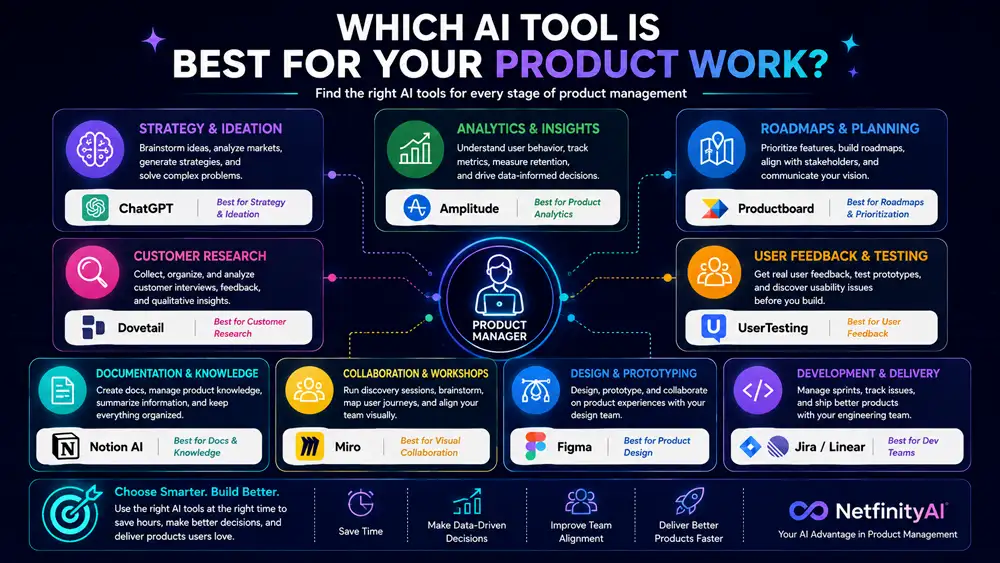
| Product Strategy | ChatGPT | Flexible brainstorming and analysis |
| Customer Research | Dovetail | Organizes and analyzes research |
| User Testing | UserTesting | Real customer feedback |
| Product Analytics | Amplitude | Deep product insights |
| Behavioral Analytics | Mixpanel | Event-based analysis |
| Roadmapping | Productboard | Product planning and prioritization |
| Strategic Roadmaps | Aha! | Long-term product strategy |
| Documentation | Notion AI | AI-assisted knowledge management |
| Project Management | ClickUp | Tasks, docs, and workflows |
| Cross-Team Projects | Asana | Team coordination |
| Engineering | Jira | Agile development workflows |
| Software Teams | Linear | Fast product development |
| UX & Prototyping | Figma AI | Design collaboration |
| Visual Workshops | Miro | Discovery and brainstorming |
| Deep AI Analysis | Claude | Complex reasoning and documents |
Best Overall AI Tool for Product Managers
ChatGPT is the strongest all-around choice because it can support research, brainstorming, analysis, writing, documentation, and strategic planning from a single interface.
Best for Product Analytics
Amplitude is a strong choice when your primary goal is understanding user behavior, feature adoption, retention, and product performance.
Best for Product Roadmaps
Productboard is particularly useful for teams that want to connect customer feedback with prioritization and product roadmaps.
Best for Customer Research
Dovetail stands out for teams that conduct frequent interviews and qualitative research and need a centralized place to organize insights.
Best for Product Design
Figma is the natural choice when product managers work closely with designers and need to collaborate around prototypes and user interfaces.
Free vs Paid AI Tools for Product Managers
Not every product manager needs an expensive collection of subscriptions. The right approach is to start with tools that solve your biggest workflow problems and add specialized platforms only when necessary.
Free or Lower-Cost Options
General-purpose AI assistants such as ChatGPT and Claude can cover many tasks without requiring a large software stack. Free tiers of project-management and collaboration platforms can also be useful for individuals and small teams.
Paid Tools
Paid platforms become more valuable when a team needs advanced analytics, larger usage limits, collaboration features, automation, research capabilities, or enterprise controls.
For example, a growing product team may benefit more from investing in a dedicated analytics platform than paying for several general-purpose AI subscriptions.
Which Should You Choose?
If you’re an individual product manager, start with one general AI assistant plus the tools your existing team already uses.
If you’re managing a larger product organization, specialized tools for analytics, research, roadmapping, and collaboration can provide significantly more value.
How to Choose the Right AI Tool for Product Management
Before subscribing to another AI platform, consider the problem you actually need to solve.
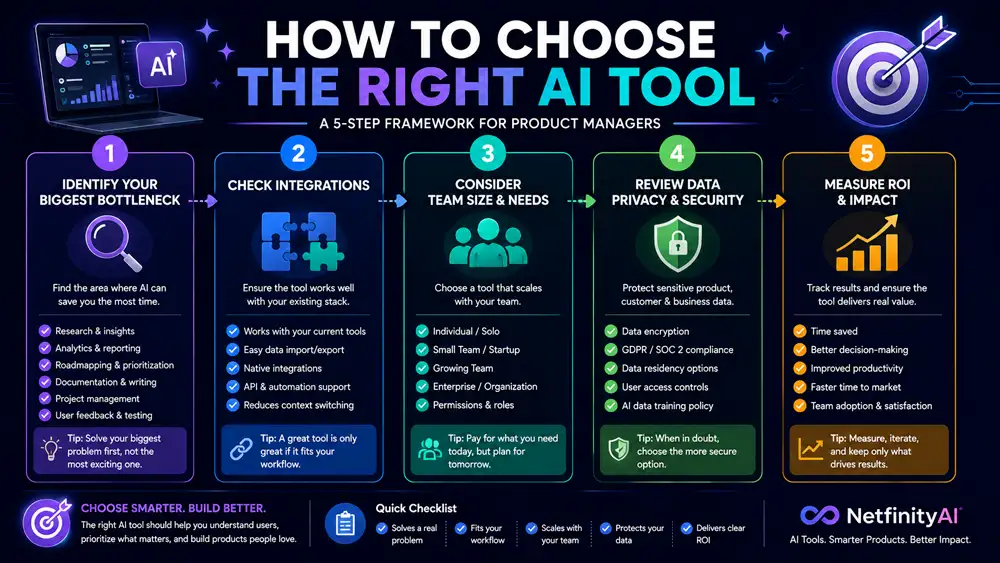
1. Identify Your Biggest Bottleneck
Are you spending too much time on research, documentation, analytics, meetings, roadmaps, or project coordination?
Start with the biggest productivity problem rather than choosing a tool simply because it is popular.
2. Check Existing Integrations
A great AI tool can become less useful if it doesn’t connect with your existing workflow.
Check whether the platform works with the tools your team already uses for communication, project management, analytics, design, and documentation.
3. Consider Team Size
An individual product manager may only need one or two flexible tools. Larger teams may benefit from dedicated platforms with collaboration, permissions, analytics, and enterprise capabilities.
4. Evaluate Data Privacy
Product managers often work with sensitive customer information, product roadmaps, business plans, and internal documents. Review each platform’s privacy policies and organizational controls before uploading confidential information.
5. Measure Actual Productivity Gains
Don’t judge an AI tool only by its feature list. Measure whether it actually saves time, improves decision-making, or helps your team deliver products more effectively.
Our Top 5 AI Tools for Product Managers
After comparing the 15 platforms, these five stand out for different product-management needs.
1. ChatGPT — Best Overall
ChatGPT is the most versatile choice for product managers who need help with research, brainstorming, analysis, writing, documentation, and strategy. Its broad capabilities make it a practical starting point for almost any product workflow.
2. Productboard — Best for Product Planning
Productboard is a strong choice for teams that need structured product discovery, prioritization, customer feedback management, and roadmapping.
3. Amplitude — Best for Product Analytics
Amplitude is particularly valuable for product managers who make decisions based on user behavior, feature adoption, retention, and product analytics.
4. Dovetail — Best for Customer Research
Dovetail is ideal for teams conducting customer interviews and qualitative research. It helps turn large amounts of research material into organized, actionable insights.
5. Figma — Best for Product Design
Figma is the strongest choice when product managers work closely with UX and product-design teams and need to collaborate around prototypes, interfaces, and design decisions.
Bottom line: There is no single winner for every product team. The best approach is to choose the platform that directly addresses your biggest workflow bottleneck.
Frequently Asked Questions
What is the best AI tool for product managers?
ChatGPT is the best overall option for many product managers because it can support research, brainstorming, analysis, documentation, and strategic work from one platform. Specialized tools may be better for analytics, roadmapping, or customer research.
Can AI replace product managers?
No. AI can automate repetitive work and assist with research, analysis, documentation, and ideation, but product managers still need human judgment, customer understanding, prioritization skills, and strategic decision-making.
What AI tools are best for product research?
Dovetail and UserTesting are strong choices for customer research, while ChatGPT and Claude can assist with analyzing research, summarizing feedback, identifying patterns, and generating questions.
What is the best AI tool for product analytics?
Amplitude and Mixpanel are strong options for product analytics. Both can help product teams understand user behavior, feature adoption, engagement, and retention.
Are AI tools worth paying for?
They can be, particularly when they save significant time or provide capabilities that free tools don’t offer. Product managers should evaluate the actual productivity benefit before adding another subscription.
How many AI tools should a product manager use?
There is no ideal number. A small, well-integrated toolset is usually better than subscribing to many overlapping platforms. Start with the tools that solve your most important problems and expand only when there is a clear benefit.
Final Verdict
The best AI tools for product managers aren’t necessarily the tools with the most features. The right choice depends on your product workflow, team size, existing software stack, and biggest productivity challenges.
For an all-purpose AI assistant, ChatGPT is our overall recommendation. For product roadmapping, Productboard is a strong choice. Amplitude stands out for analytics, Dovetail for customer research, and Figma for product design collaboration.
Rather than replacing product-management expertise, AI works best as a productivity layer that helps teams research faster, organize information, analyze data, and spend more time making high-value product decisions.